Bitdeer cloud mining separates hash rate rental from electricity charges
Bitdeer cloud mining charges separately for hash rate rental and the electricity needed to operate that capacity. The displayed rates apply per TH/s per day. The full rental fee is due upfront, while electricity can be prepaid in installments. The displayed Bitcoin plans are sold out.
The listed Antminer S19Pro plans have different terms and rental rates
Both displayed Antminer S19Pro listings use Classic mode, with different contract lengths and daily hash rate fees. The 180-day plan shows 50 TH/s and a rental rate of $0.0029 per TH/s per day. The 30-day plan shows 10 TH/s at $0.0033 per TH/s per day. Both list electricity at $0.0531 per TH/s per day.
The longer listing therefore has a lower rental rate per unit of capacity. Its larger capacity and longer term also create a larger electricity budget. A lower daily rental rate alone does not establish a lower total expense or a better mining return.
Sold-out status takes priority over the advertised start estimate
Both displayed plans show 100% sold, so their prices describe listed offers without establishing an available purchase. The cards also show an estimated start in 24 hours. That estimate does not reserve capacity or provide an activation deadline for a sold-out offer. A future listing may have different rates or conditions. Service eligibility also applies separately from stock availability, so an account and a displayed price do not establish purchase eligibility.
Rental and electricity charges use the same capacity basis
Each daily rate scales with the subscribed TH/s, while the number of days determines the corresponding charge.
The hash rate fee
The full hash rate fee is payable when the order is placed. Its calculation basis is the daily rental rate multiplied by subscribed capacity and contract duration. This fee purchases access to hashing capacity for the agreed term. A daily unit price describes that calculation; it does not divide the rental into daily payments.
The electricity fee
Electricity funding uses its daily unit rate, the same capacity and the number of electricity days purchased. The electricity label also covers mining operation and maintenance costs. It is not a household tariff per kilowatt-hour. Multiplying the displayed rate by a machine’s wattage would mix incompatible units and produce the wrong bill.
How does an electricity installment change the initial bill?
Funding fewer electricity days reduces the initial electricity payment, while the full rental charge remains due for the contract. Consider a hypothetical payment schedule that funds 13 electricity days initially instead of all 180 days. It uses the displayed 50 TH/s plan and holds the listed electricity rate unchanged for budgeting. The 13-day installment is an illustrative choice, conditional on the order accepting that selection. The listing remains sold out.
The displayed rental rate gives $0.0029 × 50 × 180 = $26.10, while the plan quotes a $26.00 hash rate fee. Use the quoted $26.00 component for this comparison. The difference means that the displayed unit rate alone does not reproduce the quoted total exactly; an actual order needs its own confirmed amount.
Daily electricity costs $0.0531 × 50 = $2.655. Funding 13 days costs $34.515 before currency rounding, making the initial combined budget about $60.52. Funding all 180 electricity days costs $477.90, making the combined budget $503.90. The smaller initial payment leaves 167 electricity days unfunded. It changes payment timing without reducing the assumed daily charge.
For the installment choice, the electricity payment record and remaining coverage must confirm the chosen 13 days before relying on that funding. That confirmation establishes prepaid coverage. It does not establish future Bitcoin output, and later electricity price changes would alter the remaining budget.
Bitdeer cloud mining: How do daily plan fees work?
- How does an electricity installment change the initial bill?
- The selected plan determines the initial electricity requirement
- Electricity renewal supports manual payments and two automatic methods
- A funding gap consumes contract time
The selected plan determines the initial electricity requirement
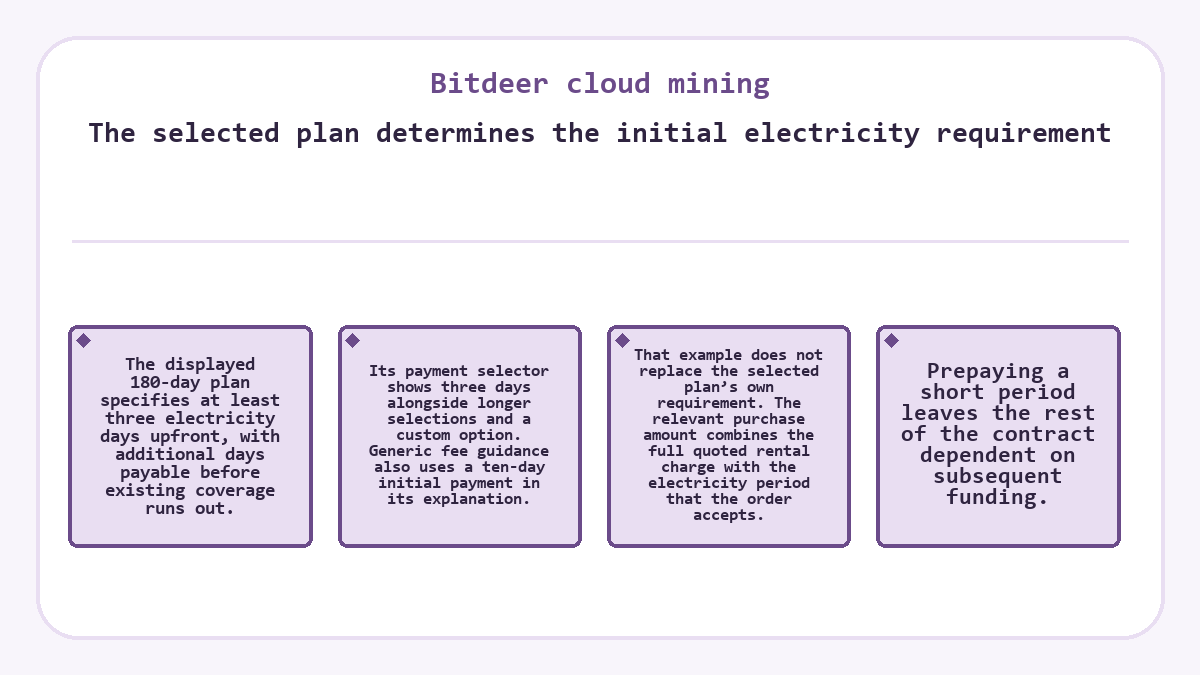
The displayed 180-day plan specifies at least three electricity days upfront, with additional days payable before existing coverage runs out.
Its payment selector shows three days alongside longer selections and a custom option. Generic fee guidance also uses a ten-day initial payment in its explanation. That example does not replace the selected plan’s own requirement. The relevant purchase amount combines the full quoted rental charge with the electricity period that the order accepts. Prepaying a short period leaves the rest of the contract dependent on subsequent funding.
Electricity renewal supports manual payments and two automatic methods
Electricity renewal supports manual payment, deductions from mining output and automatic payment from an electricity card balance.
Manual renewal
Manual renewal lets the account holder select a plan and electricity days under Pay for Electricity. Payment can use supported transfers or an electricity card balance after identity verification. The order has its own payment validity period. Creating it alone does not establish that the plan has received additional funded days.
Revenue-funded renewal
Auto-Pay with Revenue supports CloverPool, F2Pool and BnPool. It triggers below three remaining electricity days and calculates whole renewal days from mining output, including an unpaid pool balance when applicable. The plan’s maximum number of payable days limits the renewal. Insufficient funds cannot purchase a full electricity day, so this setting does not assure uninterrupted coverage.
Electricity card renewal
Automatic card payment draws on a separately funded USD balance. Below four remaining electricity days, it attempts to buy three days of coverage. It requires sufficient funds and identity verification when first authorized. Placing a manual electricity order after enabling automatic card payment blocks that automatic setting. You can re-enter automatic payment mode after the manual order expires. When both automatic methods are enabled and available, card payment takes precedence.
A funding gap consumes contract time
Allowing prepaid electricity to run out interrupts mining and revenue, and the missed days do not receive compensation. Later electricity payment does not recover the output that the plan missed during an unfunded interval. Revenue-funded renewal cannot add electricity days once an electricity funding gap stops the plan. Remaining electricity days and successful payment records therefore matter alongside the renewal setting.
Electricity price adjustments change the remaining budget
Bitdeer can adjust a plan’s electricity fee during its term to reflect the mining site’s actual electricity price. The rental fee follows a different rule: changes to advertised hash rate pricing do not affect plans already sold before the change.
A budget that multiplies one electricity rate across the entire contract assumes that rate stays unchanged. Subsequent electricity payments need the rate applicable to those payments. The rental amount already agreed and the electricity cost still to fund therefore have different exposure to later price changes.
Pool charges and payment thresholds affect received Bitcoin
The fee that the mining pool charges and its payout rules also affect what reaches the receiving wallet. A pool fee is distinct from the rental and electricity components. Electricity deductions from mining output also reduce what remains for payout when that payment method applies. A daily electricity charge does not imply a daily wallet transfer: the pool’s payment threshold governs release. Payment history records transfers, while output data records mining earnings. Treating every displayed earnings balance as received Bitcoin can overstate available funds.
Static revenue estimates need a separate cost calculation
The mining calculator estimates revenue while holding Bitcoin price, network difficulty and other changing inputs fixed. It also uses contract duration, subscribed capacity, rental and electricity charges and plan mode. Actual mining income can change after that calculation.
Electricity enters the net revenue calculation, while the static revenue percentage uses the hash rate fee as its cost base. That percentage therefore differs from a return measured against combined rental and electricity spending. The denominator matters when comparing estimates that use different definitions of investment cost.
Classic mode passes all net mining output to the customer throughout the term. Compared with Classic mode, an Accelerator offer trades a lower initial rental charge for output sharing after cost recovery. In its daily USD test, cumulative pool output minus accumulated paid electricity fees must reach the initial rental charge. Before that point, the customer keeps net output. Afterward, the order’s split applies to positive daily output after electricity. The sharing phase stays in effect once triggered.
Capacity rental and a SEALMINER purchase create different obligations
A cloud hash rate contract purchases time-limited mining capacity, while buying a SEALMINER purchases equipment with a separate operating budget. The rental arrangement avoids purchasing and maintaining the physical miner. Its recurring electricity funding and contract end date remain part of the decision.
A SEALMINER purchase adds equipment cost and the arrangements needed to operate the machine, including power and cooling. The daily cloud plan rates cannot price that alternative on their own. Compare the full cost of renting capacity with equipment ownership and its operating costs, using the same operating period.
Bitdeer cloud mining FAQs
Can a Bitdeer electricity card pay the initial hash rate fee?
A Bitdeer electricity card balance can only pay electricity fees for cloud hash rate plans. It does not pay the hash rate rental component. The balance uses USD.
Does topping up an electricity card fix the electricity price?
Adding money to a Bitdeer electricity card does not lock the electricity rate. The charge uses the electricity unit price applicable when the balance pays the electricity bill. A card top-up and a purchase of funded electricity days are separate actions, so a larger card balance does not itself establish more prepaid mining days.
When can a prepaid plan pause because mining no longer covers electricity?
Under the Risk Resistant Mining Policy, a plan pauses after its output remains below its electricity cost for 48 hours. Operation resumes shortly after output exceeds that cost for 72 consecutive hours, provided the contract has not expired. Manual operation remains an option if electricity is fully paid. During the economic pause, the plan produces no mining output and Bitdeer charges no electricity fees. The pause does not extend the contract.
Is the hash rate fee refundable after voluntary early termination?
The hash rate fee is non-refundable when an activated plan ends voluntarily because its mining results or service do not meet expectations. The termination provision allows a refund of unused electricity fees. It does not convert the rental charge into a refundable deposit, and applicable statutory rights remain unaffected.
How do cryptocurrency transfer costs affect the amount needed for an order?
A cryptocurrency payment may require additional funds for the network’s transfer fee. The plan price uses USD, while the cryptocurrency amount follows the order’s conversion rate. If a transfer fee reduces the amount that Bitdeer receives, the order may remain underpaid. Sending a transaction alone does not establish full receipt or plan activation.
Could a Bitcoin payout fall below an exchange’s minimum deposit?
A pool payout can fall below the receiving exchange’s minimum deposit even when it meets the pool’s own threshold. The two services apply separate requirements. An exchange may therefore fail to credit a small transfer. The receiving address needs to accept the asset and amount that the selected pool will actually send.
Where do small unpaid balances go after a mining plan ends?
An output balance below the pool’s minimum final payment threshold stays in the mining pool. Eligible final payments follow the pool’s final settlement rules after the order finishes. Contract completion alone does not establish that every remaining amount has reached the wallet.
Are cloud mining plans available to users in the United States?
Bitdeer’s cloud mining service excludes users in the United States, Mainland China and Seychelles. Its restrictions also cover sanctioned persons and other compliance exclusions, so that list is not exhaustive. A visible plan price or an account does not override those service restrictions. Eligibility applies before any new purchase or funding decision.