Bitdeer builds mining rigs and runs data centers
Bitdeer manufactures SEALMINER mining rigs and operates data centers that support Bitcoin mining and AI computing. Its businesses span chip design, mining hardware, cloud mining and GPU services. Customers can buy equipment, access mining hash rate when plans are available or rent computing resources for AI workloads. The company also mines Bitcoin for its own account and hosts mining equipment. These activities share infrastructure expertise, while each service involves a different resource, operating arrangement and cost structure.
SEALMINER and Minerbase connect hardware with operating sites
SEALMINER rigs provide mining hardware, while Minerbase supplies container and cooling infrastructure for operating fleets. Both sit within a business that also designs chips and develops data centers. Headquartered in Singapore, Bitdeer connects equipment manufacturing with the facilities needed to run it. Cloud mining makes hash rate accessible as a service; hosting addresses the operation of mining machines. AI Cloud extends the infrastructure business into a separate kind of computing workload.
What does a SEALMINER purchase provide?
Buying a SEALMINER provides mining hardware, with operating requirements that the installation must accommodate. An application-specific integrated circuit, or ASIC, performs calculations for a supported mining algorithm. These machines perform the hashing used in proof-of-work mining, where computational effort secures the network. Model choice matters because the algorithm and cooling design determine where the rig fits. A hydro-cooled model needs a suitable cooling installation alongside its electrical supply.
Hash rate measures computational work per second. The A3 Pro Hydro lists 660 terahashes per second, written as TH/s. The SEALMINER A3 Pro Hydro lists an energy efficiency of 12.5 joules per terahash. That efficiency figure describes energy consumed for a given amount of hashing. It needs the hash rate alongside it to establish the corresponding device power requirement.
For a hypothetical installation of 104 A3 Pro Hydro rigs, assume every unit runs at those listed ratings. Each rig’s 660 TH/s multiplied by 12.5 J/TH implies 8,250 watts, or 8.25 kilowatts, of device power.
The fleet’s calculated mining load is 104 × 8.25 = 858 kilowatts. This covers miners operating at the stated ratings and excludes pumps and other facility equipment. Changing the rig count or actual operating draw changes the fleet load. The 858-kilowatt result describes the equipment’s electrical requirement, without establishing the full site’s consumption or its Bitcoin production.
How do cloud mining and machine hosting differ?
Cloud mining provides access to mining hash rate under a plan, while hosting covers deployment, maintenance and management of physical mining machines.
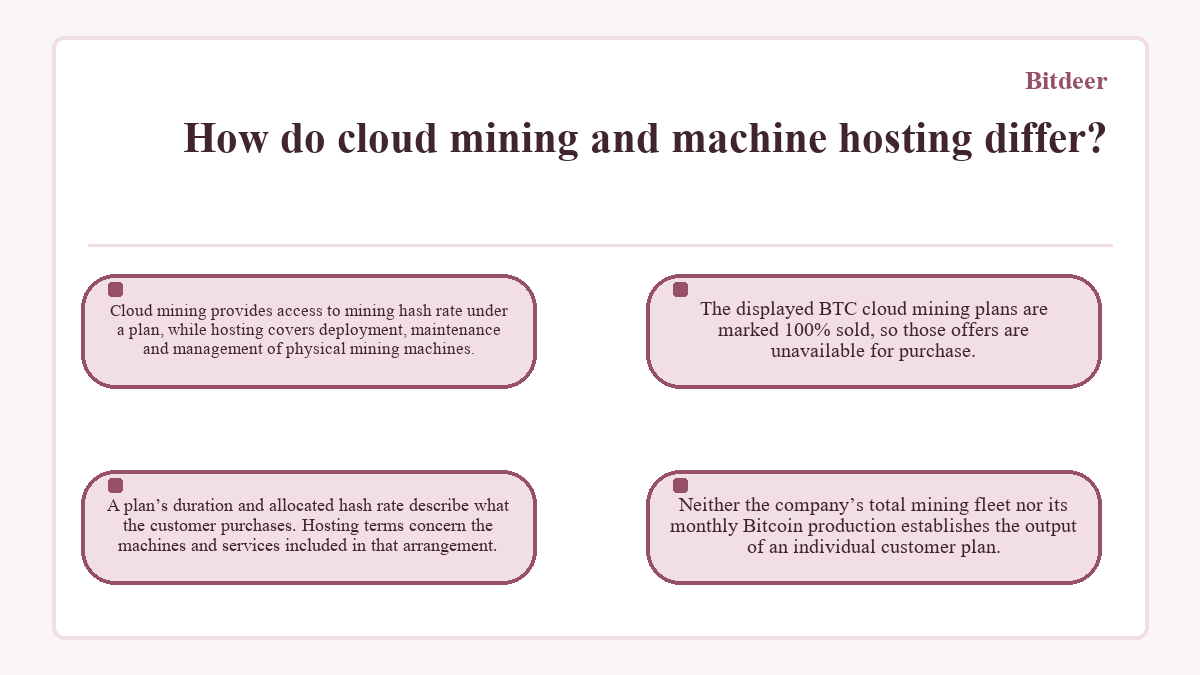
The displayed BTC cloud mining plans are marked 100% sold, so those offers are unavailable for purchase. A plan’s duration and allocated hash rate describe what the customer purchases. Hosting terms concern the machines and services included in that arrangement. Neither the company’s total mining fleet nor its monthly Bitcoin production establishes the output of an individual customer plan.
Self-mining and co-mining describe the company’s own production
Self-mining and co-mining both use the company’s rigs to mine for its own account. Their reported distinction is location: self-mining uses company-owned data centers, while co-mining uses third-party facilities. Hosting customers’ machines represents a separate business relationship, even though all these activities involve operating mining equipment.
Bitdeer Technologies Group’s unaudited May 2026 production and operations update, published on June 18, 2026, reported 70.2 EH/s of self-mining hash rate. It separately reported 10.0 EH/s of co-mining hash rate. EH/s means exahashes per second, a fleet-scale measure of computational work. An exahash equals one million terahashes.
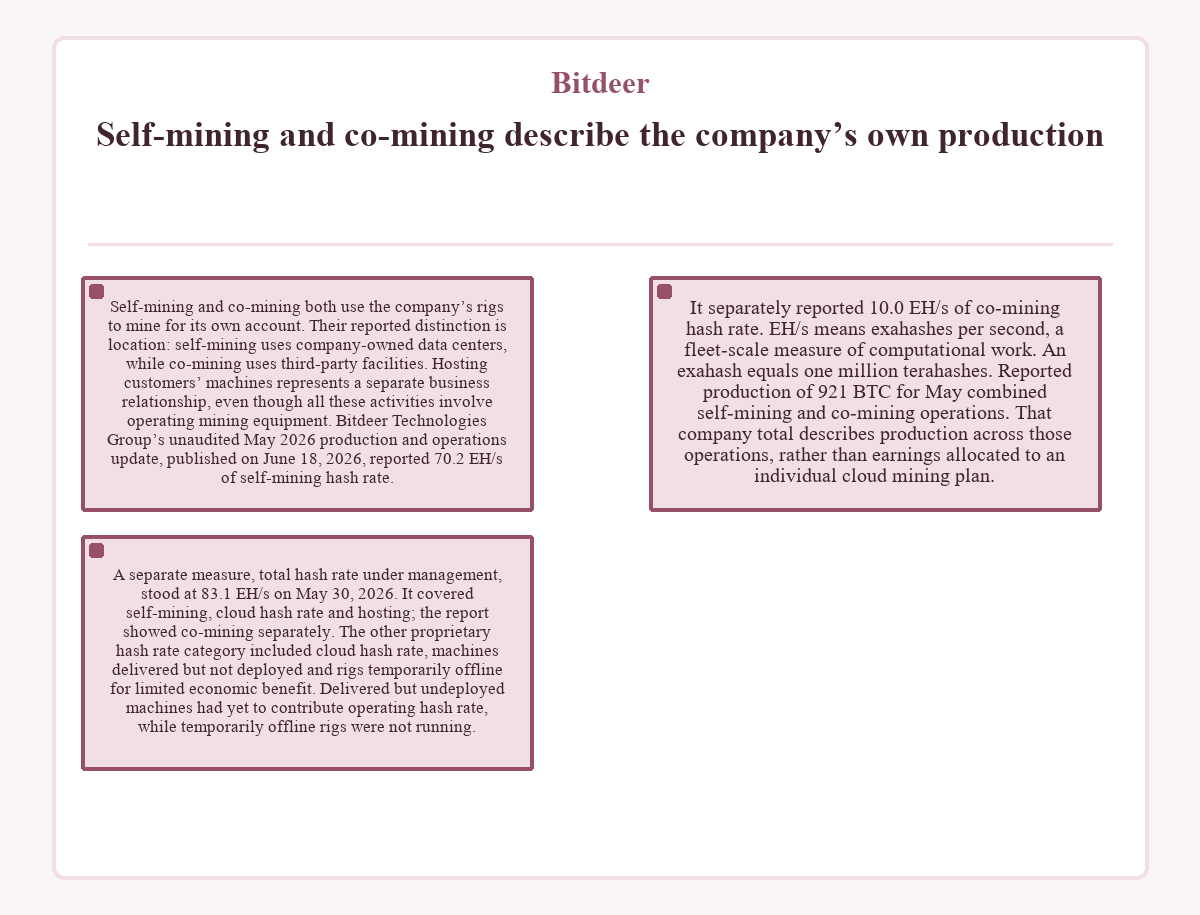
Reported production of 921 BTC for May combined self-mining and co-mining operations. That company total describes production across those operations, rather than earnings allocated to an individual cloud mining plan.
A separate measure, total hash rate under management, stood at 83.1 EH/s on May 30, 2026. It covered self-mining, cloud hash rate and hosting; the report showed co-mining separately. The other proprietary hash rate category included cloud hash rate, machines delivered but not deployed and rigs temporarily offline for limited economic benefit. Delivered but undeployed machines had yet to contribute operating hash rate, while temporarily offline rigs were not running.
GPU cloud serves AI training and inference
AI Cloud provides NVIDIA GPU resources for training models and running inference, the process of using trained models to produce outputs. GPU means graphics processing unit. These processors serve a different computing task from the ASICs inside mining rigs. The infrastructure includes NVIDIA H100, H200, B200 and GB200 hardware. In its June 18, 2026 update, the company reported completing deployment and production launch of two NVIDIA GB300 NVL72 clusters. An individual AI order requires an available configuration that suits its workload.
TH/s describes hashing performance for the mining algorithm. An AI workload needs suitable GPU resources for model computation. A mining rig’s hash rate provides no direct measure of how much training or inference capacity a GPU service supplies.
Does announced power capacity mean an AI data center is ready?
Announced power capacity does not establish that an AI data center has completed construction or conversion. The May 2026 infrastructure snapshot separated 1,797 MW of online electrical capacity from 1,206.5 MW in the pipeline. Its combined 3,003.5 MW portfolio figure therefore included future capacity.
The data center footprint spans the United States, Norway, Bhutan and Ethiopia. The May update also listed leased AI Cloud capacity in Cyberjaya, Malaysia. Different locations support different workloads. That update described an AI transition evaluation in Rockdale, Texas. It also reported advanced negotiations with a potential colocation tenant in Tydal, Norway. Colocation provides data center facilities for a tenant’s computing equipment. An existing mining operation can require further construction and conversion before supporting its intended AI deployment.
The app brings equipment purchases and mining tools together
The app combines SEALMINER purchases, Minerbase containers, accessories and cloud mining plans with announcements and mining calculators.
The selected item determines what a purchase covers. A physical rig, a container and a hash rate plan represent different resources. Calculators help compare mining inputs, while network difficulty, pool fees and market prices affect the economics of the work. A return estimate changes when its assumptions change, even if the equipment’s published specifications remain the same.
Costs follow the equipment or service selected
Hardware ownership ties costs to the machine and the facility that powers and cools it. The displayed cloud mining plans list separate hash rate and electricity fees. GPU cloud charges concern computing resources for a chosen workload. These payments purchase different things, so comparing their headline amounts alone cannot establish the cost of meeting the same requirement.
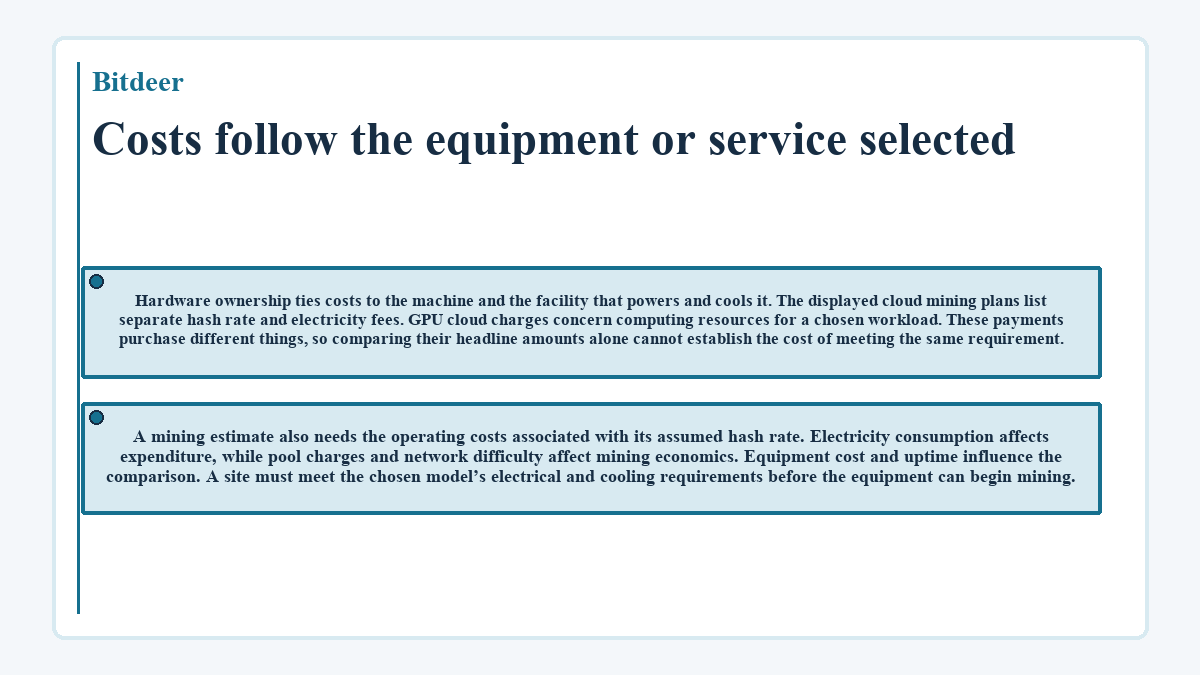
A mining estimate also needs the operating costs associated with its assumed hash rate. Electricity consumption affects expenditure, while pool charges and network difficulty affect mining economics. Equipment cost and uptime influence the comparison. A site must meet the chosen model’s electrical and cooling requirements before the equipment can begin mining.
Bitdeer: questions and answers
What does Bitdeer’s BTDR ticker identify?
BTDR identifies Bitdeer Technologies Group’s Nasdaq-listed shares. It refers to an ownership interest in the company, distinct from a mining rig or cloud mining plan. Company mining production and AI infrastructure form part of the operating business associated with those shares.
Does every SEALMINER model use the Bitcoin mining algorithm?
The SEALMINER range includes equipment for different mining algorithms. The June 18, 2026 operations update described the launch of the DL1 Hydro for Scrypt mining, which differs from Bitcoin’s SHA-256 algorithm. Compatibility follows the particular model’s supported algorithm, so the full model designation matters when selecting equipment.
Are customer deposits included in the reported Bitcoin holdings?
Customer Bitcoin deposits did not form part of the holdings figure in the May 2026 operations update. The definition included company Bitcoin pledged as collateral. That inclusion matters when comparing reported holdings with Bitcoin free of collateral commitments; the holdings total does not distinguish between those states.
How is AI Cloud ARR calculated?
AI Cloud ARR measures an annualized revenue run rate from contractually obligated GPU orders. The May 2026 definition multiplied the daily revenue from those orders on the month’s final day by 365. This describes the run rate associated with active contracts at that point, rather than revenue already earned over a full year.
Which orders count toward reported GPU utilization?
The May 2026 definition counted GPUs under both internal and external orders when calculating utilization. It divided that total by all deployed GPUs on the month’s final day. External customer subscriptions therefore represent only part of the numerator; the utilization percentage cannot be read as the external subscription rate.
Can SEALMINER reservation rights be transferred through the app?
The app includes a marketplace for transferring SEALMINER reservation rights. A transfer concerns that right; it does not, by itself, describe delivery of the physical mining rig.
Is programmatic model access available through AI Model Studio?
AI Model Studio supports model access through a serverless inference API, an application programming interface that lets software request model outputs. The June 18, 2026 update reported deployment of NVIDIA Nemotron 3 Nano Omni through that interface.