Bitdeer reported managed hash rate separately from co-mining in May 2026
Bitdeer reported 83.1 EH/s under management in May 2026, combining self-mining, other proprietary hash rate and hosting capacity. It listed 10.0 EH/s of co-mining separately. Its definition also covered rigs delivered to mining data centers before deployment and rigs temporarily offline for economic reasons.
On this page
In short: The May 2026 managed hash rate definition covered rigs delivered to mining data centers but not yet deployed and rigs temporarily offline for economic reasons, while co-mining appeared separately.
The components behind the 83.1 EH/s total
The managed total combined business lines with different operating roles and different relationships to the company’s own production. Bitdeer Technologies Group published its unaudited May 2026 production and operations update on June 18, 2026. The footnote for total hash rate under management specifies May 30, 2026. Hash rate measures hashing work per second, with EH/s meaning exahashes per second.
| Reported category | May 2026 hash rate | Operating scope |
|---|---|---|
| Self-mining | 70.2 EH/s | Company-owned rigs mining for its own account in its own data centers |
| Other proprietary hash rate | 4.7 EH/s | Cloud hash rate, rigs delivered to mining data centers but not yet deployed and rigs temporarily offline for economic reasons |
| Hosting | 8.2 EH/s | Mining machine deployment, maintenance and management services |
Adding the components gives 70.2 + 4.7 + 8.2 = 83.1 EH/s. Using it as a measure of exclusively active, own-account mining would change the meaning of the metric.
What does other proprietary hash rate include?
Other proprietary hash rate combined the cloud hash rate business with undeployed rigs and rigs temporarily offline because of limited economic benefit. Its May 2026 value was 4.7 EH/s.
Rigs delivered to mining data centers before deployment fell within this category. Delivery and deployment therefore described different operating states. Including a machine’s capacity in this reporting category did not establish that it was contributing active hashing work.
The temporarily offline group had a stated economic condition. Its presence does not establish a technical fault or a permanent retirement. Equally, retaining that capacity in the category does not show that the machines generated Bitcoin during their offline periods.
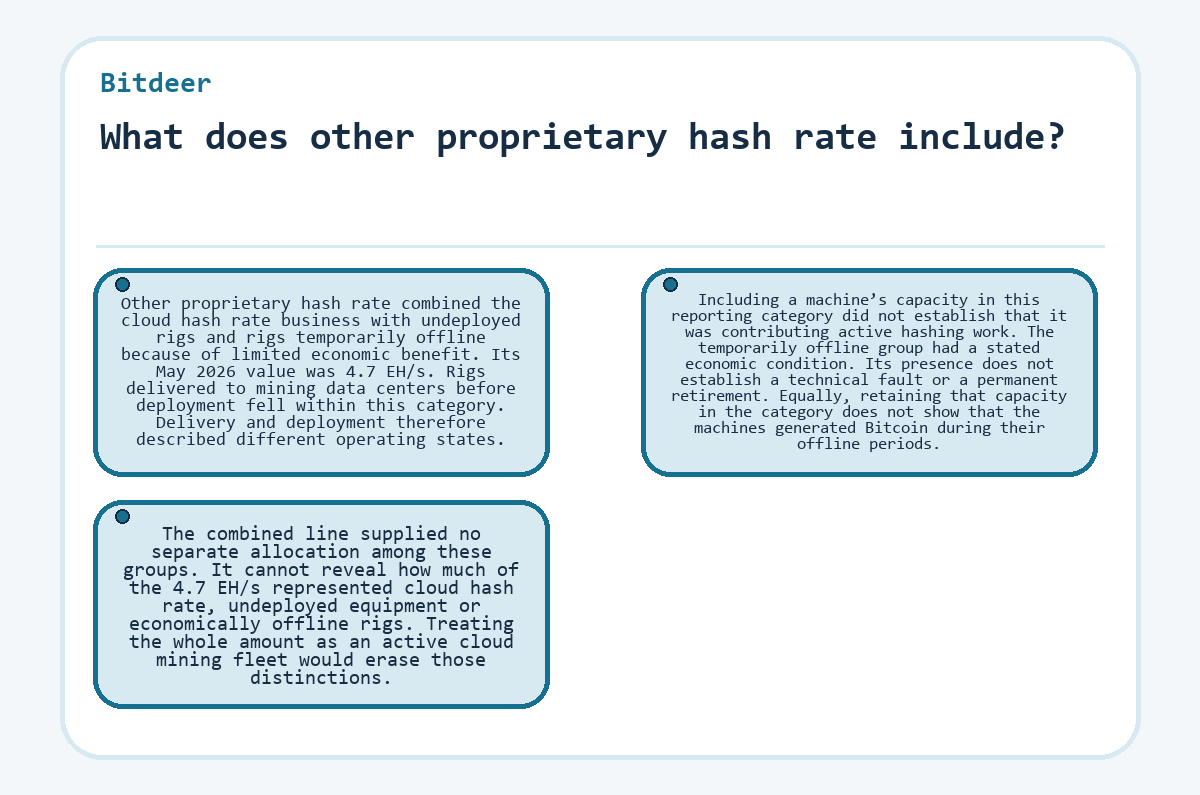
The combined line supplied no separate allocation among these groups. It cannot reveal how much of the 4.7 EH/s represented cloud hash rate, undeployed equipment or economically offline rigs. Treating the whole amount as an active cloud mining fleet would erase those distinctions.
Where does co-mining sit in the figures?
Co-mining appeared outside the managed total, with a separate May 2026 figure of 10.0 EH/s. The May 2026 definition described co-mining as the company’s own rigs mining for its own account in third-party data centers.
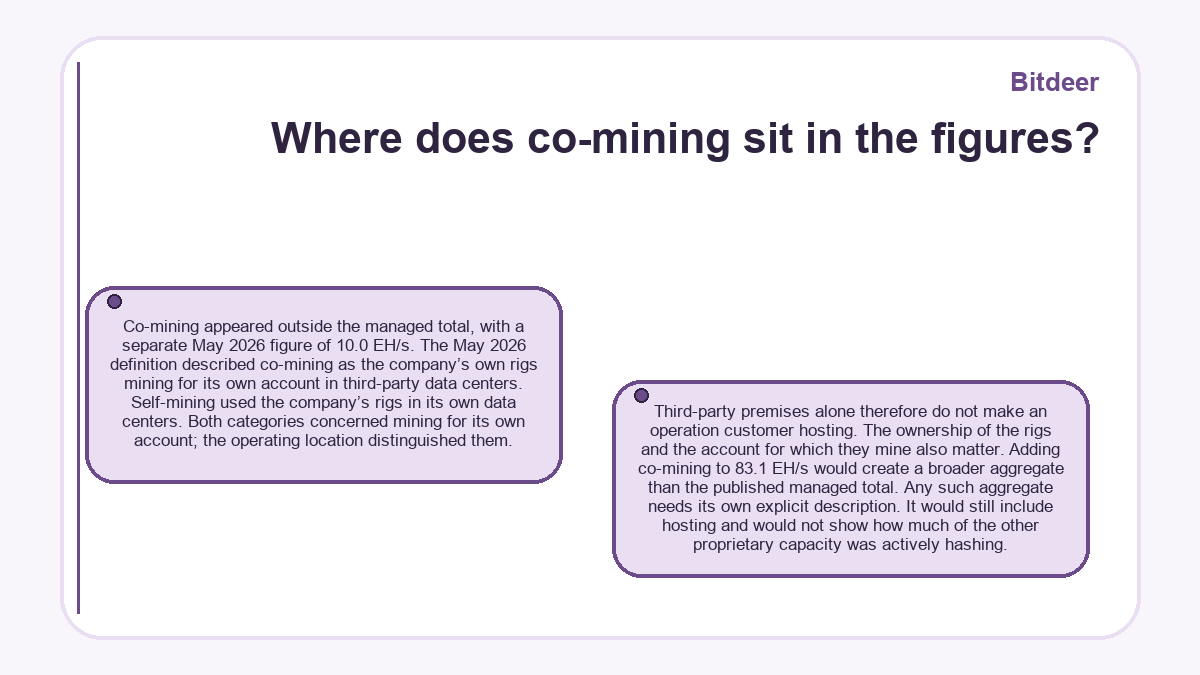
Self-mining used the company’s rigs in its own data centers. Both categories concerned mining for its own account; the operating location distinguished them. Third-party premises alone therefore do not make an operation customer hosting. The ownership of the rigs and the account for which they mine also matter. Adding co-mining to 83.1 EH/s would create a broader aggregate than the published managed total. Any such aggregate needs its own explicit description. It would still include hosting and would not show how much of the other proprietary capacity was actively hashing.
Does the managed total represent active Bitcoin production?
The managed total does not establish that every included rig was hashing, and it does not measure monthly Bitcoin output. EH/s expresses a rate of computational work. BTC measures an amount of Bitcoin, so production figures also need a defined period and operating scope. The company reported 921 BTC mined during May 2026, including production from self-mining and co-mining. That production boundary differs from the managed hash rate boundary. Co-mining contributed to the reported Bitcoin output despite sitting outside the 83.1 EH/s total. Hosting belonged within that hash rate total without becoming part of its own-account production definition.
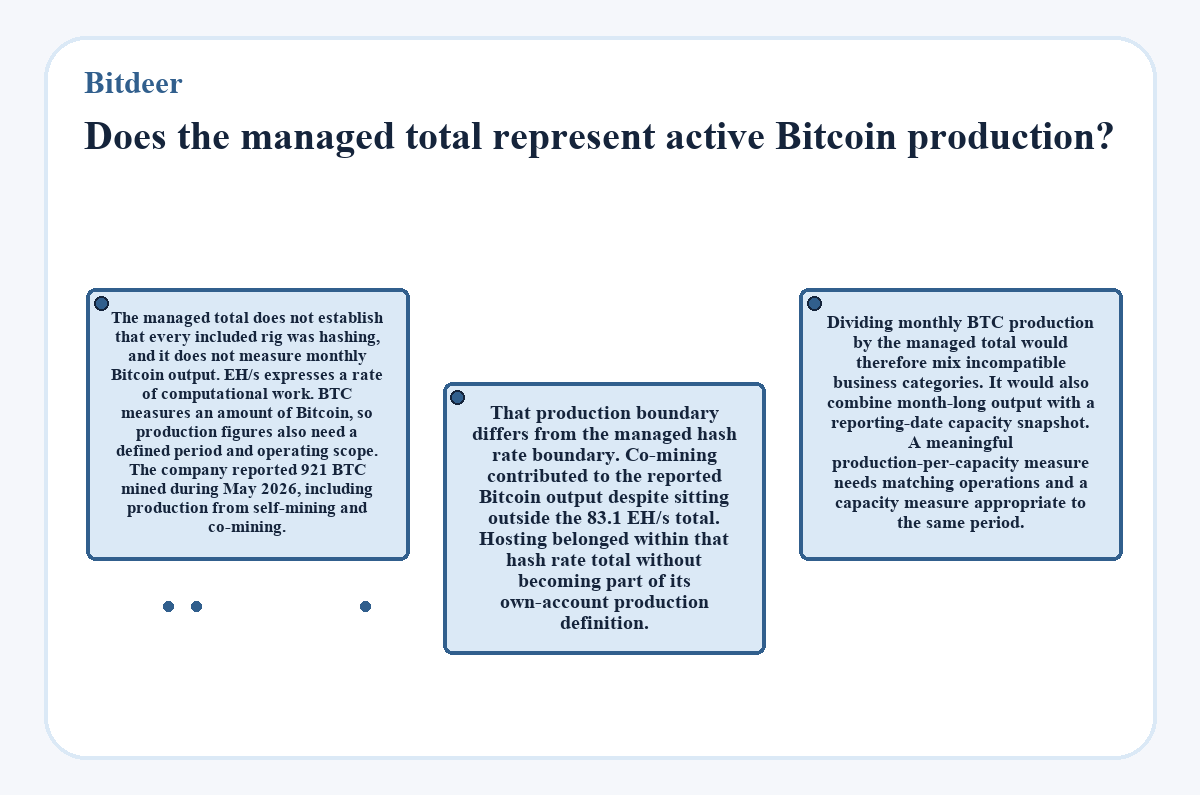
Dividing monthly BTC production by the managed total would therefore mix incompatible business categories. It would also combine month-long output with a reporting-date capacity snapshot. A meaningful production-per-capacity measure needs matching operations and a capacity measure appropriate to the same period.
Rig counts require their own reconciliation
The May 2026 figures listed 231,000 self-mining rigs and 46,000 hosted rigs, giving 277,000 rigs under management. Another 39,000 co-mining rigs appeared separately. The hash rate table also lists other proprietary capacity, without a corresponding rig-count breakdown. Model and operating-state differences also prevent a machine count from becoming a uniform measure of hashing capacity.
April and May show different movements within the total
Between April and May 2026, self-mining hash rate rose from 65.5 to 70.2 EH/s, while hosting stayed at 8.2 EH/s. Other proprietary hash rate fell from 5.3 to 4.7 EH/s.
The managed total increased from 79.0 to 83.1 EH/s across those months. Growth in self-mining more than offset the lower other proprietary figure. Hosting added no change to that comparison.
Co-mining rose separately from 8.4 to 10.0 EH/s. Its increase expanded the company’s own-account mining capacity in third-party facilities. It did not contribute to the increase within the published managed total.
The lower other proprietary figure alone does not identify what changed within that category. The combined amount does not distinguish a movement in cloud hash rate from a movement in undeployed or temporarily offline capacity. Assigning the decrease to one subgroup would require a separate breakdown.
Electrical power and SEALMINER efficiency describe different quantities
Electrical capacity measures power infrastructure, while hash rate measures computational work per second. MW and GW are power units. The infrastructure portfolio covered crypto mining, AI Cloud and colocation uses, with online and pipeline capacity reported separately. A portfolio-wide power figure therefore does not establish an operating Bitcoin hash rate.
SEALMINER efficiency specifications relate energy consumption to hashing work for a particular machine. Joules per terahash, written as J/TH, express the energy needed for that work. Device power and efficiency can help explain a rig’s capacity, but a product specification does not describe the mix of models across a managed fleet. A conversion from electrical capacity to mining hash rate would need the power actually allocated to mining and the relevant equipment efficiency. Capacity intended for another computing workload cannot simply enter that conversion. Undeployed or offline equipment also needs separate treatment when the intended measure is active hashing.
A consistent basis for comparing reported mining scale
Comparisons with another mining operator need matching business categories as well as matching units. A figure limited to own-account mining has a different scope from one that includes hosting services. Operating location adds another distinction when a company places its own rigs in third-party facilities. Management scope, machine ownership and production entitlement answer different questions.
The May figures support comparisons of each named business line across the reported periods. They do not provide a separate active-capacity figure for every subgroup. Where a comparison requires that missing detail, the managed total cannot supply it. Keeping the original categories intact prevents a larger service footprint from becoming an overstated estimate of the company’s Bitcoin-producing capacity.
Common questions, answered
How much hashing does one EH/s represent?
One EH/s represents 1,000,000,000,000,000,000 hashes per second, equivalent to 1,000,000 TH/s. The unit conversion changes the scale of the number without changing the underlying activity. It does not establish whether a reported capacity figure covers active equipment, customer hosting or mining for the company’s own account.
Can the reported cloud-related capacity be purchased as a mining plan?
The other proprietary hash rate figure does not identify capacity available for purchase. It combines cloud hash rate with rigs delivered to mining data centers but not yet deployed and rigs temporarily offline for economic reasons. A mining plan has its own availability, duration and commercial terms; none of those follows from the aggregate capacity reported for May 2026.
Does a dash in the May 2025 co-mining column mean zero capacity?
The dash does not supply a numerical value of zero for May 2025 co-mining capacity. It leaves that comparison without a stated numeric base. The May 2026 value can therefore support a comparison with the reported April 2026 figure, but the dash cannot support a calculated year-over-year growth rate.
Did hosted hash rate fall between May 2025 and May 2026?
Hosted hash rate fell from 13.7 EH/s in May 2025 to 8.2 EH/s in May 2026. That comparison concerns the hosting business alone. The decline coexisted with growth in the managed total because self-mining and other proprietary hash rate increased across those reporting periods.
Is mining profitability measurable from the managed hash rate alone?
Hash rate alone cannot establish mining profit because it supplies neither complete costs nor realized revenue. Electricity charges and equipment efficiency affect operating costs, while network difficulty, pool fees and Bitcoin’s market price affect the economics of production. Including undeployed or temporarily offline rigs adds another limitation to the managed total.
What else is needed to estimate a share of Bitcoin’s network hash rate?
A network-share estimate needs applicable active Bitcoin hash rate and a Bitcoin network estimate covering a comparable period. The May 2026 managed definition does not isolate active equipment, so dividing its total directly by a network estimate would not establish the company’s active share. The calculation also needs an explicit treatment of hosted customer equipment.
Do matching hosted totals prove that the same rigs ran continuously?
Matching hosted totals do not establish uninterrupted operation of the same individual machines. The update listed 8.2 EH/s and 46,000 hosted rigs for both April and May 2026. Those aggregate figures identify neither individual equipment nor uptime between reporting dates, so they cannot demonstrate continuous operation throughout the intervening period.